Traditional Jewellery of Himachal Pradesh and Its Cultural Meaning
The traditional jewellery of Himachal Pradesh is an important expression of the state's cultural identity, artistic heritage and regional diversity. Nestled in the western Himalayas, Himachal Pradesh is home to communities with distinct clothing styles, ceremonial customs and jewellery traditions. From elaborate silver necklaces to traditional nose rings, forehead ornaments and decorative bangles, these accessories reflect generations of craftsmanship and cultural knowledge.
Himachali traditional jewellery is valued for more than its appearance. In many communities, ornaments are associated with weddings, festivals, family traditions and important social occasions. Some pieces are passed down through generations, carrying memories of family members and connections to local heritage.
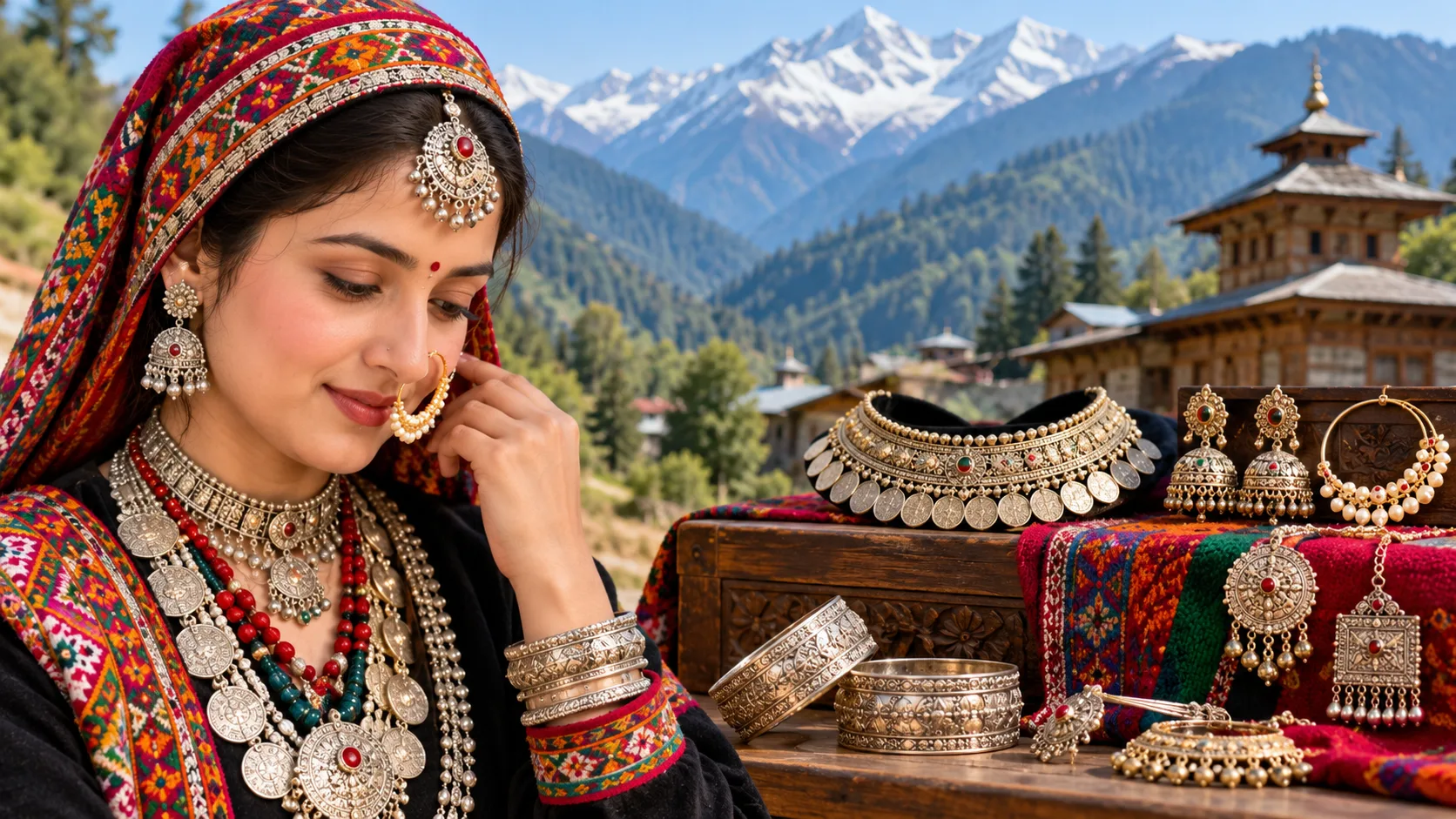
The jewellery worn in Chamba, Kangra, Kullu, Kinnaur and other Himalayan regions differs in design, materials and customary use. Silver ornaments are particularly prominent in many regional traditions, while gold and other decorative materials are also used. Pieces such as Chiri, Nath, Balu, Chandrahaar, Karanphool and traditional silver bangles are notable examples of the variety found across the state.
Exploring the traditional ornaments of Himachal Pradesh offers a fascinating insight into the relationship between jewellery, regional dress, craftsmanship and community life. Understanding these ornaments also helps preserve the cultural knowledge behind their designs and use.
The History of Traditional Jewellery in Himachal Pradesh
The history of traditional Himachali jewellery is closely connected with the everyday lives, social customs and artistic traditions of Himalayan communities. Over generations, local artisans developed ways to shape metals into ornaments suited to regional clothing and ceremonial requirements.
Jewellery-making skills were often transmitted through families and artisan communities. Goldsmiths and silversmiths developed specialised knowledge of metalworking, decorative patterns and ornament construction. Although designs changed over time, many traditional forms continued to represent local identity and established customs.
How Traditional Jewellery Developed in Himalayan Communities
The mountainous geography of Himachal Pradesh contributed to the development of distinct regional cultures. Communities maintained their own clothing traditions, celebrations and forms of personal adornment, creating a varied landscape of jewellery styles.
Traditional ornaments were designed to complement local attire and suit different occasions. Some were relatively simple and suitable for regular use, while others featured elaborate metalwork and decorative elements intended for weddings, festivals and ceremonies.
Artisan knowledge played an important role in maintaining these traditions. Techniques for shaping silver, creating decorative surfaces and assembling complex ornaments were passed from experienced craftspeople to younger generations.
However, jewellery traditions were never entirely uniform across the state. Designs and customary uses varied according to region, community, household traditions and individual preferences.
The Role of Gold and Silver in Himachali Jewellery
Silver has an important place in the traditional jewellery of Himachal Pradesh. Its versatility allows artisans to create a wide variety of forms, including necklaces, bangles, earrings, nose rings and other decorative ornaments.
Silver can be shaped into broad surfaces, curved structures and intricate decorative elements. Depending on the ornament, artisans may use engraving, textured metalwork, raised details or decorative wirework to create distinctive designs.
Gold is also used in traditional jewellery, particularly in ornaments associated with special occasions and ceremonial attire. The choice of metal depends on regional customs, design preferences, family circumstances and the intended use of a piece.
In some households, precious-metal jewellery also represents a form of financial security. Such ornaments may be retained for years, repaired when necessary and passed down as family heirlooms.
How Regional Traditions Influenced Jewellery Designs
Regional variation is one of the most interesting aspects of Himachali traditional jewellery. Communities developed different styles in response to local clothing, cultural influences, artisan practices and ceremonial customs.
The jewellery associated with Chamba may differ from ornaments worn in Kangra or Kinnaur. Even within a single district, neighbouring communities can have different preferences regarding the size, shape and combination of ornaments.
These differences demonstrate that traditional Pahari jewellery is not one fixed style. It represents a collection of interconnected traditions that have developed within the diverse cultural landscape of the western Himalayas.
Popular Traditional Jewellery of Himachal Pradesh and Their Meanings
The traditional jewellery of Himachal Pradesh includes ornaments for the forehead, nose, ears, neck, wrists, ankles and hair. Each category offers a different example of the craftsmanship and decorative preferences found across the region.
The names and designs of individual ornaments can vary between communities. Therefore, the following examples should be understood as part of a broader regional heritage rather than a universal jewellery set worn by everyone in Himachal Pradesh.
Chiri or Chiri Tikka: Traditional Forehead Jewellery
Chiri, sometimes referred to as Chiri Tikka, is associated with traditional forehead adornment in documented Himachali dress traditions, particularly among Gaddi communities.
Forehead ornaments are visually prominent because they frame the face and complement traditional headwear and clothing. Depending on the design, such pieces may feature decorative metalwork, suspended elements or carefully shaped motifs.
Their appearance can vary according to local custom and the style of traditional attire with which they are worn.
For communities that continue to use traditional dress on ceremonial occasions, forehead jewellery can contribute to a distinctive regional appearance. It also illustrates how ornaments are designed as part of a wider clothing tradition rather than as isolated accessories.
Nath and Balu: Traditional Nose Ornaments
Nath and Balu are names associated with traditional nose ornaments in Himachali jewellery traditions. Nose rings can differ in size, shape, decorative details and customary use.
Some designs are relatively understated, while others are more elaborate and form a prominent part of ceremonial or bridal adornment. Their appearance depends on regional preferences and the occasion for which they are worn.
In communities where traditional bridal jewellery remains important, nose ornaments may complement necklaces, earrings, forehead pieces and other accessories.
The terms Nath and Balu should not be treated as interchangeable descriptions of one identical design. Their forms and meanings can differ across local traditions, making regional context important when identifying a particular ornament.
Chandrahaar and Chandrasanihaar: Traditional Necklaces
Chandrahaar and Chandrasanihaar are names associated with traditional necklace forms. Neck ornaments are an important category of Himachali jewellery because they can be designed to complement both everyday clothing and elaborate ceremonial attire.
Some necklace styles feature multiple rows, decorative pendants or carefully arranged metal elements. Others may emphasise a central ornament or a repeated pattern.
The arrangement of these elements affects the necklace's appearance and how it sits with traditional clothing.
Elaborate necklaces can form part of festive and bridal jewellery, where several ornaments are combined to create a coordinated appearance. Their design also demonstrates the ability of traditional artisans to work with repeated forms, metal shaping and decorative details.
Karanphool and Jhumka: Traditional Earrings
Karanphool and Jhumka are examples of traditional earrings found in broader North Indian and Himalayan adornment traditions, although their exact forms and use can vary locally.
Karanphool designs may feature floral-inspired shapes, while Jhumka earrings are generally recognised by their hanging, bell-like structure.
These earrings can be crafted with curved metal surfaces, textured details and decorative elements that add movement and visual interest.
Earrings are often chosen to complement other ornaments, including necklaces and forehead jewellery. In traditional attire, their shape and size contribute to the overall balance of the ensemble.
When exploring Himachali traditional jewellery, it is important to recognise that familiar ornament names may refer to different designs in different regions.
Dodmala and Jaumala: Traditional Necklaces
Dodmala and Jaumala are names associated with traditional necklace styles in some regional jewellery traditions.
Certain traditional necklaces feature multiple rows of beads, metal elements or repeated decorative components. Their construction may vary depending on local preferences and the materials available to artisans.
Necklaces can be worn as individual accessories or combined with other neck ornaments for ceremonial occasions.
The variety of traditional necklace designs illustrates how regional jewellery balances decorative appeal with established clothing customs. However, the names, materials and precise forms of these ornaments should be verified against the relevant community's traditions before attributing a particular design to a specific district.
Kangnu, Silver Bangles and Gorju
Traditional wrist ornaments are another important component of Himachali jewellery. Bangles and other wrist accessories can feature smooth surfaces, raised patterns, engraved details or decorative metalwork.
Kangnu is a name associated with traditional wrist adornment, while silver bangles are a broader category found in many regional jewellery traditions.
Depending on the design, wrist ornaments may be worn individually or in combinations. Their weight, finish and decorative complexity can differ according to local custom and personal preference.
In some households, metal bangles may also have sentimental or family significance, particularly when they are retained and passed down through generations.
Together with necklaces, earrings and nose ornaments, traditional wrist jewellery helps create a coordinated appearance that reflects the wearer's clothing and cultural background.
Toke, Hansli and Other Neck Ornaments
Traditional neck ornaments in Himachal Pradesh include a variety of shapes and structures. Among the forms associated with regional jewellery traditions are rigid or torque-like necklaces, including ornaments described as Hansli in broader North Indian usage.
Such ornaments may sit closely around the neck and feature curved metal structures or decorative elements.
Their appearance depends on the materials, construction techniques and local design conventions used by artisans.
Neck ornaments can be particularly striking when worn with traditional clothing because their shape contrasts with the softer lines of fabric. Some designs are intended for ceremonial wear, while others may form part of established regional dress.
The names and forms of individual pieces should be interpreted in their local context, as terminology can vary between communities.
Paijeb and Other Traditional Anklets
Paijeb refers to a traditional anklet form found across several Indian jewellery traditions. Anklets may be made from silver or other materials and can feature simple bands, decorative links or more elaborate designs.
In traditional attire, anklets provide a finishing detail that complements ornaments worn on the upper body.
The use of ankle jewellery varies between communities, occasions and individual preferences. Some pieces are associated with ceremonial dressing, while others may be worn as personal adornment.
Like other traditional ornaments, anklets demonstrate how jewellery can extend beyond the head, ears, neck and wrists to form part of a complete approach to regional dress.
Traditional Hair and Head Ornaments
Hair and head ornaments help complete traditional attire in several Himalayan communities. These may include forehead pieces, decorative bands and other accessories designed to complement local hairstyles or head coverings.
Chauk and Shringar-patti are names associated with head or forehead adornment in broader regional jewellery traditions, although their exact forms and use should be confirmed for the specific Himachali community being discussed.
Head ornaments can feature metalwork, repeated decorative patterns or carefully arranged elements that frame the face.
Their visual importance is especially evident when worn with traditional clothing during weddings, festivals and other ceremonial occasions.
Understanding these pieces requires attention to the relationship between jewellery, hairstyle, headwear and local clothing customs.
Regional Variations in Himachali Traditional Jewellery
Himachal Pradesh has a diverse cultural landscape, and its jewellery traditions reflect that variety. The traditional jewellery of Chamba may differ from Kangra's ornaments, while Kinnauri and Kullu traditions have their own distinctive relationships with regional dress.
These differences should not be reduced to rigid district-wide categories. Jewellery styles can vary between neighbouring communities and may change according to the occasion, household traditions and individual preferences.
Traditional Jewellery of Chamba
Chamba is known for its rich cultural heritage, traditional arts and distinctive regional identity. Its jewellery traditions form part of a wider cultural landscape shaped by local communities, clothing customs and ceremonial practices.
The district includes communities such as Gaddis and Pangwals, alongside other groups with their own cultural traditions. These communities should not be assumed to wear identical ornaments or follow the same customs.
Among Gaddi communities, traditional attire and jewellery can contribute to a recognisable regional appearance. Forehead ornaments, earrings, necklaces and other accessories may form part of ceremonial dressing, depending on local practice.
The designs worn in Chamba can also be understood alongside the district's historic settlements, temples, architecture and artistic heritage. To explore this wider historical context, read our guide to historical places in Himachal Pradesh.
Examining the region's history alongside its living traditions helps visitors appreciate how clothing, ornamentation and community identity contribute to Chamba's cultural character.
Traditional Jewellery of Kangra
Kangra has a long-standing artistic heritage, and its traditional ornaments form part of the region's broader material culture.
Gold and silver have been used in different forms of regional jewellery. Depending on the ornament, decorative features may include engraved surfaces, floral motifs and other carefully worked details.
Traditional adornment can encompass head ornaments, earrings, nose rings, necklaces and wrist accessories. The specific combination depends on the community, the occasion and the wearer's preferences.
The region's jewellery should also be understood in relation to its wider craft traditions. Metalworking, painting, textiles and other artistic practices contribute to Kangra's cultural identity, although each craft has its own history and techniques.
Rather than assuming that all Kangra ornaments follow one design language, it is more accurate to recognise the variety of styles associated with the region and its communities.
Traditional Jewellery of Kullu
Kullu is known for its distinctive clothing traditions and vibrant cultural celebrations. Jewellery worn with regional attire contributes to the visual identity of the area's communities.
Silver ornaments are an important part of many traditional Himalayan jewellery collections. Necklaces, earrings and other metal accessories can complement local clothing, particularly during weddings, festivals and ceremonial gatherings.
The appearance of jewellery varies according to local traditions and individual choices. An ornament worn for a formal celebration may differ in size or decoration from one used more regularly.
Kullu's cultural heritage is best understood through the relationship between jewellery, textiles, local celebrations and community life. Each element contributes to the overall appearance of traditional attire.
Traditional Jewellery of Kinnaur
Kinnaur has distinctive clothing traditions shaped by its Himalayan geography, local history and diverse communities.
Traditional jewellery worn in Kinnaur can include metal ornaments and accessories that complement regional clothing and headwear. The materials, forms and decorative details differ according to local practices.
Headwear is an important visual feature of traditional dress in parts of Kinnaur. Jewellery worn alongside it can contribute to the distinctive appearance of ceremonial attire.
However, Kinnaur is culturally diverse, and no single jewellery style represents every community in the district. Traditions can differ between localities and households, and some practices have changed over time.
A respectful exploration of Kinnauri traditional jewellery therefore considers specific communities and documented examples rather than treating the entire region as culturally uniform.
Jewellery Traditions of Lahaul, Spiti and Other Himalayan Communities
Lahaul and Spiti are home to communities with distinctive cultural practices, clothing traditions and local histories. Their forms of personal adornment should be understood within these specific contexts.
Jewellery traditions across these areas may differ from those found in Chamba, Kangra or Kullu. Materials, decorative forms and customary uses can vary according to local practice and individual preference.
The wider Himalayan region also includes cultural influences that cross modern administrative boundaries. Similar ornament names or shapes do not necessarily mean that two communities share identical traditions.
Documenting these differences is important for preserving an accurate understanding of Himachal Pradesh's cultural heritage.
What Does Traditional Himachali Jewellery Symbolise?
Traditional Himachali jewellery can carry several layers of meaning. Although the significance of individual ornaments varies between communities, jewellery can express cultural identity, family connections, artistic preferences and participation in important social occasions.
Understanding these meanings requires looking beyond the appearance of a piece and considering the circumstances in which it is worn.
Cultural Identity and Community Heritage
Traditional jewellery can help communicate a connection to a particular region or community. When worn with local clothing, distinctive ornaments contribute to the visual identity of traditional attire.
Certain designs may be associated with particular communities, ceremonial practices or family traditions. Their continued use can help maintain a visible connection with cultural heritage.
Jewellery can also become a way for younger generations to learn about the clothing and customs of older family members.
However, cultural identity cannot be determined by jewellery alone. Individual preferences, changing lifestyles and differences between communities all influence how ornaments are worn today.
Jewellery at Weddings and Ceremonial Occasions
Weddings are important occasions for traditional adornment in many Himachali communities.
Depending on local customs, bridal jewellery may include necklaces, earrings, nose ornaments, forehead pieces and bangles. These accessories complement traditional clothing and help create an appearance suited to the ceremony.
Some families retain particular ornaments for weddings and other important events. Such pieces may be inherited or borrowed within a family, giving them sentimental value beyond their material worth.
Bridal jewellery is not identical throughout Himachal Pradesh. The combination of ornaments depends on regional dress traditions, family practices and personal choices.
Jewellery, Beliefs and Spiritual Traditions
In some Indian and Himalayan traditions, particular ornaments or amulets have been associated with protection, good fortune or spiritual significance.
These beliefs are culturally specific and should not be treated as universal features of Himachali jewellery. Their meaning depends on the community, the object and the traditions surrounding its use.
Certain ornaments may also have symbolic importance because they are worn during ceremonies or inherited from family members.
Understanding these associations requires reliable documentation of the relevant local practice rather than assuming that every decorative object carries a spiritual meaning.
Jewellery as a Symbol of Family Wealth and Inheritance
Precious-metal jewellery has historically served several purposes in many households. In addition to personal adornment, gold and silver ornaments can represent stored wealth.
In some families, jewellery is inherited and passed between generations. Such pieces may be kept for weddings, special occasions or other significant moments.
Inherited jewellery can hold both financial and emotional value. The ornament itself may represent family continuity, memories of earlier generations and a connection to a shared past.
The importance of jewellery as wealth or inheritance varies according to household circumstances and local traditions, so it should not be assumed to apply equally to every family.
Jewellery as an Expression of Artistic Identity
Traditional ornaments also showcase the creativity of local artisans.
Floral motifs, geometric patterns, textured surfaces and carefully shaped metal elements can give jewellery its distinctive character. Different techniques produce different finishes, allowing artisans to create pieces that reflect local preferences.
The design of an ornament is influenced by its intended use, the materials available and the skills of the craftsperson.
Traditional Pahari jewellery therefore offers an opportunity to appreciate the artistic knowledge involved in metalworking as well as the cultural meaning of the finished object.
Traditional Jewellery in Himachali Weddings and Festivals
Weddings, festivals and community celebrations provide important settings in which traditional jewellery may be worn.
On these occasions, ornaments form part of a broader ensemble that includes clothing, headwear, hairstyles and other accessories. Their appearance reflects local traditions, but the precise combination varies between communities.
Ornaments Worn with Traditional Bridal Attire
Himachali bridal jewellery can include necklaces, earrings, nose ornaments, forehead jewellery and bangles. In some communities, additional accessories may complement traditional headwear or other elements of ceremonial dress.
The overall appearance depends on regional customs and the clothing worn for the wedding.
Some brides wear elaborate metal ornaments, while others prefer lighter pieces or a combination of traditional and contemporary jewellery.
Family heirlooms can also have a place in bridal adornment. An inherited ornament may be valued for its history and emotional significance as much as its design.
There is no single bridal jewellery set that represents every community in Himachal Pradesh. Understanding these differences is essential when exploring Himachali bridal jewellery.
Jewellery During Local Fairs and Cultural Celebrations
Local fairs and cultural celebrations offer opportunities to observe traditional attire in public settings.
In many Himalayan communities, traditional clothing and ornaments are worn during selected festivals, religious occasions and cultural gatherings. The jewellery chosen for these events can reflect local identity and family customs.
Chamba's Minjar Mela is one example of the region's important cultural celebrations. To learn more about this event and its heritage, read our article on the Minjar Mela of Chamba.
Traditional jewellery can contribute to the appearance of ceremonial attire during cultural gatherings, but specific ornaments should not be described as compulsory for a festival unless reliable documentation supports that claim.
How Jewellery Traditions Differ Between Everyday Wear and Special Occasions
Traditional ornaments vary in complexity according to their intended use.
Everyday jewellery may be relatively simple, lightweight and practical. Ceremonial pieces, by contrast, may feature larger forms, more elaborate decoration or a greater combination of ornaments.
These distinctions are not absolute. Some people wear traditional jewellery regularly, while others reserve particular pieces for weddings and festivals.
Contemporary preferences also influence how ornaments are used. Lighter designs and modern adaptations can allow traditional motifs to remain part of present-day clothing.
The difference between everyday and ceremonial jewellery is therefore best understood as a reflection of individual circumstances and community practices rather than a universal rule.
Traditional Jewellery-Making Techniques in Himachal Pradesh
The beauty of traditional jewellery depends not only on its design but also on the skills involved in making it.
Goldsmiths and silversmiths use specialised knowledge to transform metal into ornaments of different shapes, sizes and levels of complexity. The techniques used for a particular piece depend on its construction, decorative requirements and the artisan's training.
The Role of Local Goldsmiths and Silversmiths
Local goldsmiths and silversmiths have played an important role in maintaining traditional jewellery practices.
Their work may involve selecting and preparing metal, shaping individual components, assembling the ornament and refining its surface.
Creating a balanced and wearable piece requires both technical ability and an understanding of how the ornament will be used.
Artisans may also repair older jewellery, restore damaged components or adapt traditional designs to meet contemporary preferences.
These services help keep existing ornaments in circulation and can support the continued use of traditional designs.
Traditional Metalwork, Engraving and Filigree
Traditional metalworking can involve several techniques, depending on the ornament and the artisan's practice.
Shaping and forming metal establish the basic structure of a piece. Engraving can add lines, motifs and decorative details to its surface, while other methods create raised textures or repeated patterns.
Filigree is a specialised technique that uses fine metal wires to create delicate decorative designs. It should be attributed to particular ornaments or artisan traditions only where its use is documented.
Not every Himachali ornament uses the same techniques. Different pieces require different approaches, and the methods used can vary between workshops and regions.
Enamel Work and Decorative Motifs
Some traditional jewellery traditions use enamel to introduce colour to metal surfaces. Enamel work can produce vivid decorative details, depending on the materials and methods involved.
However, enamel should not be assumed to be a defining feature of every regional jewellery tradition in Himachal Pradesh. Its use must be established for the specific ornament or community being discussed.
Other decorative approaches include floral patterns, repeated geometric forms and textured metal surfaces.
These details demonstrate how artisans balance practical construction with artistic expression. The resulting ornaments can reflect established design preferences while allowing room for individual craftsmanship.
How Craftsmanship Is Passed Between Generations
Traditional craft knowledge is often preserved through practical experience.
Younger artisans may learn by observing experienced craftspeople, assisting with production and gradually developing the skills required to make complex ornaments.
Family workshops and local artisan networks can help preserve knowledge of traditional forms and working methods.
However, craft traditions can face challenges when fewer young people choose to pursue specialised metalworking or when demand for particular ornaments declines.
Recording designs, supporting skilled artisans and encouraging interest in traditional craftsmanship can help maintain these valuable practices.
How Traditional Himachali Jewellery Is Changing Today
Traditional jewellery continues to evolve as lifestyles, fashion preferences and consumer expectations change.
Some people continue to wear traditional ornaments at weddings and festivals, while others choose lighter designs or modern accessories inspired by regional motifs.
These changes do not necessarily mean that traditional jewellery has lost its cultural importance. Instead, they demonstrate how communities and individuals adapt inherited styles to contemporary life.
From Heavy Silver Ornaments to Lighter Designs
Some traditional silver ornaments are substantial in size or weight. Although such pieces can make a striking visual statement, they may not suit every person's daily routine or preferences.
Contemporary wearers may prefer lighter ornaments that are easier to use with modern clothing and everyday activities.
Jewellers may also adapt traditional designs by changing their proportions, simplifying decorative details or using different construction methods.
The extent of these changes varies between regions and individual buyers. Heavy traditional ornaments continue to have a place in some ceremonial settings, while lighter alternatives may appeal to people seeking greater practicality.
Traditional Jewellery in Modern Fashion
Traditional Himachali jewellery can also inspire contemporary fashion.
Designers and jewellery makers may adapt familiar shapes, decorative patterns or metalwork details for use with modern clothing.
A traditional motif can be incorporated into a smaller pendant, a pair of earrings or a contemporary necklace. Such adaptations can make regional design elements accessible to people who do not regularly wear traditional attire.
However, modern interpretations should not be confused with historical originals. Understanding the difference helps buyers appreciate both traditional craftsmanship and contemporary design.
Challenges in Preserving Traditional Jewellery Craftsmanship
Traditional jewellery-making faces several potential challenges.
Changing consumer preferences can reduce demand for specialised ornaments. The time and skill required to create intricate pieces may also make them more expensive than mass-produced alternatives.
In some areas, the availability of experienced artisans may become a concern if fewer younger craftspeople enter the profession.
Another challenge is the loss of detailed knowledge about individual ornaments, including their local names, construction methods and cultural significance.
Documenting regional designs, recording artisans' knowledge and supporting skilled craftspeople can help preserve these traditions for future generations.
How Visitors Can Appreciate and Support Local Craftsmanship
Visitors interested in traditional Himachali jewellery can learn about the craft by exploring local handicrafts, speaking with artisans and observing documented examples of regional ornaments.
When buying jewellery, it is helpful to ask about the material, the method of production, the artisan or workshop responsible for the piece and its regional inspiration.
Buyers should also distinguish handmade traditional ornaments from contemporary designs that borrow regional motifs. Both can have value, but understanding their differences makes purchasing decisions more informed.
For an introduction to local handicrafts and cultural retail traditions, explore our article on Himachal Emporium and traditional handicrafts.
Before planning an in-person visit to a particular outlet, confirm its current location, opening hours and available collections.
Supporting knowledgeable artisans and responsible craft businesses can help sustain the skills behind traditional jewellery.
Where to Learn More About Himachal Pradesh's Jewellery Heritage
Traditional jewellery becomes easier to understand when it is explored alongside the clothing, history and community traditions with which it is associated.
Museums, cultural collections, artisan workshops and regional heritage resources can provide useful starting points.
Museums and Collections of Traditional Ornaments
Museums and documented collections can help visitors study traditional ornaments, materials and decorative styles.
When researching a particular piece, look for reliable information about its origin, date, materials and community association. Collection descriptions and curatorial documentation can help distinguish verified regional examples from broad claims about traditional jewellery.
Not every museum will have a dedicated collection of Himachali jewellery, so it is worth checking current catalogues and visiting information before making plans.
Photographs and collection records can also be useful for comparing ornament shapes and identifying variations between regions.
Exploring Traditional Jewellery Alongside Local Dress
Jewellery is best understood as part of a wider clothing tradition.
The same ornament may look different when worn with different fabrics, head coverings or ceremonial garments. Its placement can also influence how it is perceived.
Traditional clothing provides important context for interpreting jewellery. It helps explain why certain accessories are worn together and how ornaments contribute to a region's distinctive appearance.
When studying photographs or museum collections, consider the complete ensemble rather than focusing only on individual pieces.
The Connection Between Traditional Attire and Community Life
Traditional attire often reflects the history, environment and social practices of the community in which it developed.
In Himachal Pradesh, clothing and jewellery traditions are connected with local celebrations, family customs and ways of life that differ between regions.
Gaddi communities, for example, have cultural traditions closely associated with the Himalayan landscape and pastoral life. Their clothing and adornment can be explored as part of this broader cultural context.
To learn more about this community and its traditional way of life, read our article on Gaddi shepherds of Himachal Pradesh.
Understanding these connections helps visitors appreciate traditional jewellery as part of a living culture rather than simply as a decorative object.
Preserving the Cultural Meaning of Himachali Jewellery
The traditional jewellery of Himachal Pradesh represents a valuable part of the state's cultural and artistic heritage.
From silver bangles and elaborate necklaces to nose ornaments and forehead jewellery, these pieces reflect the creativity of artisans and the diversity of regional clothing traditions.
Their significance extends beyond appearance. In different communities and households, jewellery may be connected with weddings, family inheritance, ceremonial customs and regional identity.
Preserving this heritage requires more than retaining old ornaments. It also involves documenting local names, recording the techniques used by artisans and understanding the specific customs associated with individual pieces.
It is equally important to recognise regional differences accurately. An ornament associated with one community should not automatically be presented as representative of the entire state.
Visitors, researchers and jewellery enthusiasts can contribute by learning from reliable cultural resources, supporting skilled craftspeople and approaching traditional designs with respect for their origins.
As traditional and contemporary styles continue to interact, Himachali jewellery remains a meaningful way to explore the relationship between craftsmanship, identity and community life.
By understanding the stories behind these ornaments, we can help ensure that the cultural knowledge they represent continues to be appreciated by future generations.
Frequently Asked Questions
More from
Himalayas Digital
Top 25 Singers in Himachal Pradesh: Famous Himachali Artists You Should Know

IPL 2026 in Dharamshala: Match Dates, Tickets, Hotels & Complete Travel Guide

Hemis Monastery: Ladakh’s Largest & Most Famous Gompa

Manki Point Kasauli: Complete Travel Guide (2026) – Timings, Entry Fee, History & How to Reach